Beyond the hand that signs, the document has a body: paper, ink, printing, seals and security features. It is that body which reveals the interpolation, the swapped page and the certificate that never left the notary's office.
Beyond the signature
The entire document is the object of examination
When the dispute is about the signature, the examination turns to the writer's hand. When the dispute is about the document, the object is another: the substrate that carries it, the ink that marks it, the equipment that printed it, the security features that should have protected it. A document may bear an authentic signature and still be false, because it was altered after being signed, because a page was replaced, or because the public instrument it imitates never existed.
This examination answers questions that handwriting comparison alone cannot reach: was the certificate really issued? Does the deed bear the public seal of the notary it declares? Was the added clause inserted before or after the signature? Did every page of the contract come out of the same equipment?
Public documents
Certificates, deeds and powers of attorney
Notarial public seal and signature acknowledgement, inspection stamp, security paper, numbering and register of origin. The examination compares the questioned specimen with standards issued by the same notarial office and with the characteristics declared in the document itself.
Private documents
Contracts, receipts, negotiable instruments and cheques
Interpolations and later additions, abusive filling of blank spaces, chemical and mechanical erasures, replacement of sheets, divergence between counterparts of the same instrument.
Printing process
The print that identifies the equipment
Inkjet, laser and toner, dot matrix, typewriter, rubber stamp and date stamp each leave their own patterns: deposition, granulation, repetitive defects, alignment. Two different printers in a single contract are a finding, not a detail.
Sequence of entries
What went onto the paper first
Did the signature come before or after the printed text? That is the question that decides contracts, and it has its own section further down this page.
Under magnification
Every printing process leaves a signature of its own
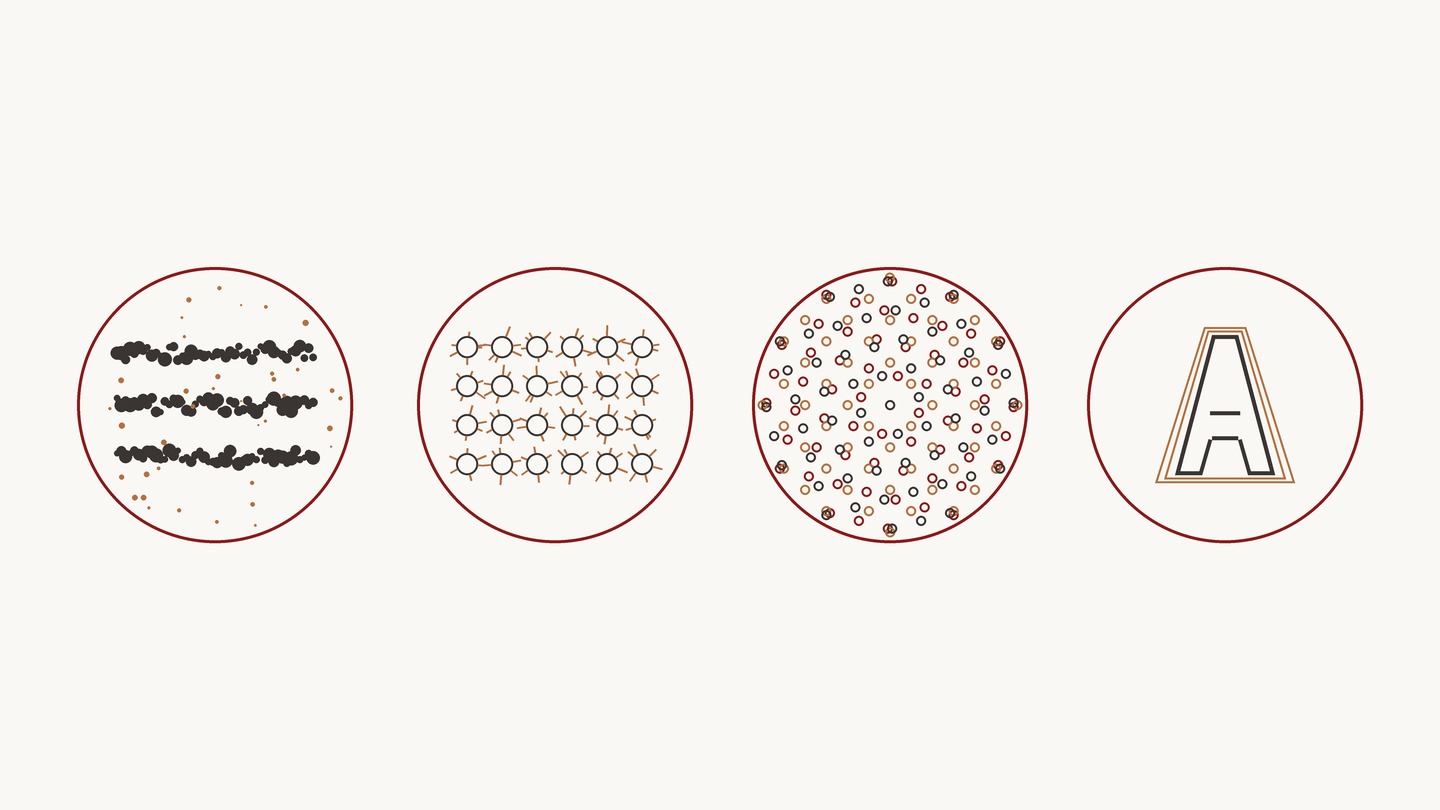
Before discussing content, the examination identifies how that document was produced. The distinction is made under magnification and answers practical questions: did the pages come out of the same equipment? Is the document the original or a reproduction presented as one? Was the disputed passage added by a different process?
From left to right: laser toner, inkjet, offset halftone screen and mechanical impact.
ElectrophotographyLaser and toner: particles fused to the paper, with characteristic gloss, satellite specks scattered around the stroke and edges that do not penetrate the fibre
InkjetRounded droplets that bleed along the paper fibres, with satellite droplets and diffuse outlines under magnification
OffsetHalftone screen set at different angles for each colour, forming the rosette pattern: indicates industrial graphic production rather than office printing
ImpactTypewriter and dot matrix: embossing on the reverse, sharp edges, vertical misalignment and repetitive defects that individualise the equipment
Rubber stampIrregular deposition, halo of excess ink at the edges and flaws that repeat in every impression from the same die
ReproductionLoss of resolution, scanning screen pattern and absence of embossing expose the copy presented as an original
Typewritten documents
The typewriter still decides cases
The typewritten document has left everyday life, but it has not left the case files. Wills, old deeds, corporate contracts, minutes, anonymous letters and land title documents keep arriving for examination, and they are precisely the ones carrying the greatest financial value. In such cases the question is rarely about the signature: it is about the text that precedes it, and about when that text was typed.
The examination works on two successive levels, and confusing them is the error that hollows out an expert report. First the class is determined: what type of machine produced that text. Then individualisation is sought: whether that text came from that specific machine, and not from another of the same model.
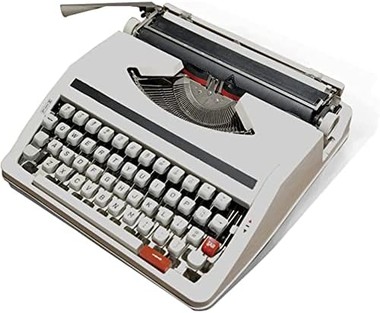
Mechanical type-bar machineEach type bar is an independent part, and each part accumulates its own defects: that is what makes it possible to individualise the machine.
What determines the class
Type design: the shape of each character identifies manufacturer and model
Horizontal pitch: ten or twelve characters per inch, among other standards
Line spacing and character height
Available repertoire: accents, cedilla, symbols that the model carried
Printing system: type bars, interchangeable typeball, daisy wheel or dot matrix
What individualises the machine
Broken or worn type, or casting flaws in specific characters
Vertical and horizontal misalignment of isolated characters
Characters tilted or rotated in relation to the baseline
Impression consistently stronger or weaker in the same character
Build-up of dirt in the enclosed areas of closed letters, with a pattern of its own
These defects are accidental, they arise from use and evolve with it. That is why they serve individualisation and also relative dating: a type element that was not yet broken in one document, and already was in another, places the two in chronological order.
The machine changes, the examination changes
MechanicalType bars driven by a hammer: each character has its own part, and each part accumulates its own defects. It is the one that individualises best
Electric typeballInterchangeable printing element: changing the ball changes the typeface without changing the machine, which demands extra caution in the conclusion
Daisy wheelReplaceable petal disc, with the same caution as the typeball: the wear belongs to the disc, not to the equipment
ElectronicText memory and lift-off correction tape: the trace ceases to be purely mechanical and comes to include what the machine stored
Dot matrixPins forming the character out of dots: the technical signature lies in the matrix pattern and in the defective pins
The evidence almost nobody looks for
The ribbon keeps what was written
Single-use carbon ribbons always advance forward and record, in sequence, everything that passed through them. When the ribbon is preserved together with the machine, the typewritten text can be recovered in the order in which it was produced, including passages that appear in no document at all. Fabric ribbons, which re-ink and overwrite, do not allow that reading. That is why, when the case allows it, machine and ribbon should be seized and sealed together with the document.
Two classic frauds depend on this examination. The first is the interpolation: the document is typed leaving a gap, and the decisive passage is added later, sometimes years later. The horizontal and vertical alignment of the inserted text does not match the rest, ink density differs, and even when the fraud uses the same machine, the type defects have evolved in the meantime.
The second is the anachronism: the document claims a given date, but was produced on a machine, with a typeface or with a feature that did not yet exist in that year. Lift-off correction, carbon ribbon, certain type designs and specific models entered the market at known moments, and a document displaying them cannot predate them.
InterpolationAlignment, density and the evolution of defects expose the passage added later
AnachronismFeature or model that did not exist on the date declared by the document
ComparisonExemplars typed on the suspect machine, taken under protocol and with the ribbon preserved
RecordCalibrated photomicrography of every defect, so that the court can check the finding with its own eyes
The question that decides contracts
Did the signature come before or after the printed text?
It is one of the most contested questions in court, and for good reason: on it depends whether the party signed what is on the paper or signed a sheet that received its content afterwards. An added clause, an altered amount, a sheet signed in blank and filled in later: all these scenarios are resolved at the same point of the examination, where handwriting ink meets the print.
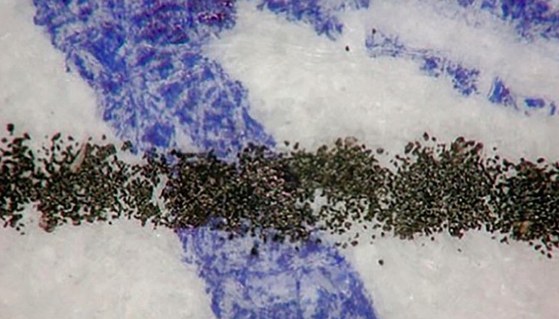
Where the two entries cross, the answer lies in the superposition of the layers, and it is read under magnification. Laser toner is a particle fused to the paper, with a body of its own: when the pen passes over it, the ballpoint adheres poorly to the fused layer, the stroke fails or breaks at points along its path and may even drag particles along. When the print is deposited last, it covers the ink stroke that was already there, and that is what the image alongside shows.
The examination does not rest on optical reading of the intersection alone. The furrow left by the pen crosses the printed area and is legible under raking light and on the reverse of the sheet; the continuity of the stroke over the printed region, or its interruption, adds a further element; and comparison between the counterparts and the pages of the same instrument completes the picture.
When there is no intersection at all, because the signature sits on the reserved line and touches nothing, the expert report says so in plain words. There are promising lines of research for that scenario, still consolidating in the literature, and none of them authorises a categorical conclusion today. Declaring the absence of elements is a technical answer, and it protects the client: a conclusion built on an unconsolidated method does not survive adversarial scrutiny.
Which came first: the pen or the print? In the magnified intersection, the toner granules sit on top of the ballpoint stroke: the print was deposited after the ink was already on the paper.
IntersectionMicroscopic examination of the crossing point: which layer overlies the other and how the stroke behaves over the print
EmbossingPen furrow crossing the printed area, legible under raking light and on the reverse of the sheet
ContinuityBehaviour of the stroke as it runs across the printed region: gaps and interruptions are elements of examination
Internal comparisonComparison between counterparts and between pages of the same instrument, looking for divergence of substrate and of equipment
No intersectionAbsence of a crossing point declared in the expert report, with the limitation made explicit instead of filled in by inference
Instruments applied to the substrate
Each light source answers a question
UV light 365 nmFluorescence of paper and inks, halos left by chemical washing and programmed security features that react only under ultraviolet
InfraredDifferentiation of inks that look identical to the naked eye and reading of what lies beneath obliterations and stamps
Transmitted lightWatermarks, interpolations, patches, pasted areas and irregularities in the body of the paper
Raking lightPressure furrows and reliefs invisible under frontal illumination, including indented writing from the sheets above
MicroscopyStroke morphology, toner granulation, ink deposition and repetitive defects of the printing equipment
MeasurementPaper thickness micrometer and forensic millimetre scales, with calibrated photomicrography attached to the expert report
The bridge to the digital
When the document arrives as a PDF, the examination shifts layer
A scanned copy retains neither pressure nor embossing, and the conclusion it allows is a different one. The file, on the other hand, retains internal structure, metadata and editing layers. That is why questioned document examination and computer forensics work together here. See Digital Questioned Document Examination.
The machine that signs: from the eighteenth-century automaton to today's fraud
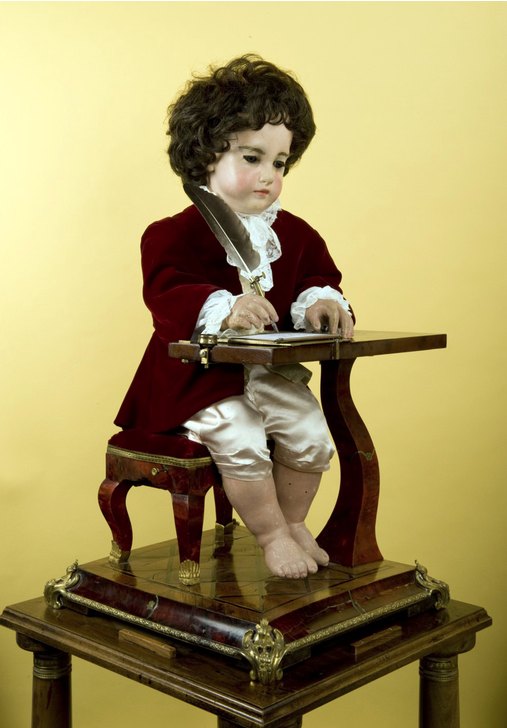
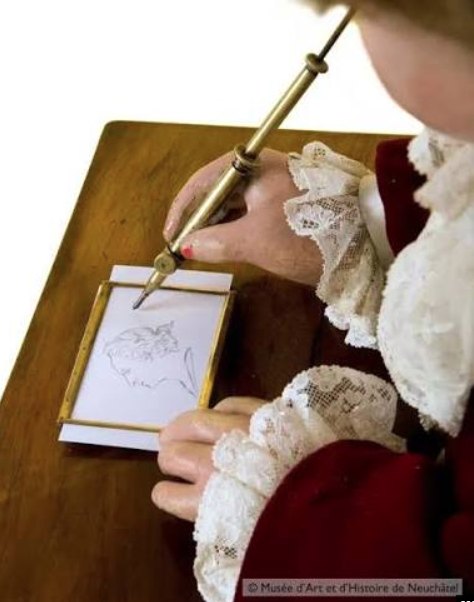
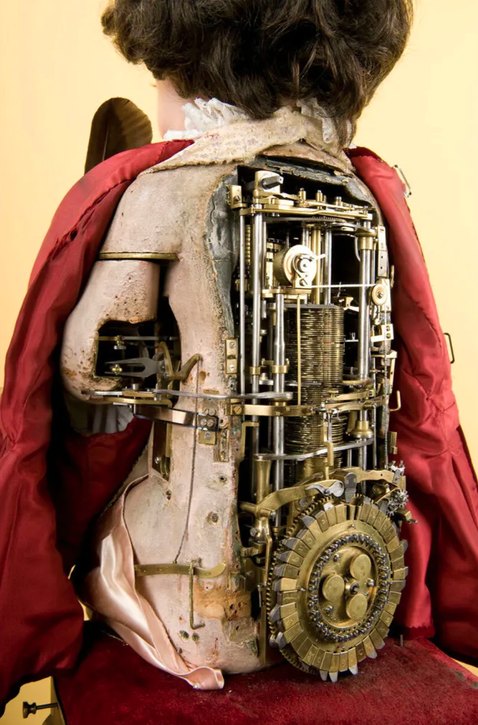
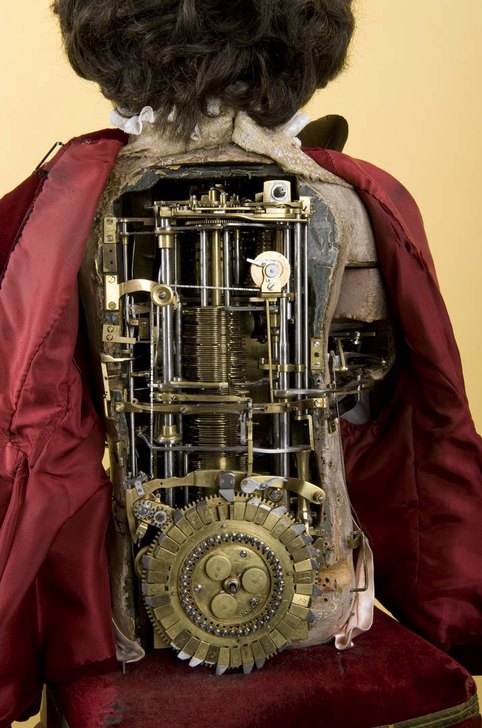
The idea of a machine that writes with a real pen does not belong to the digital age. A Swiss watchmaker, Pierre Jaquet-Droz, built in the second half of the eighteenth century a seventy-centimetre automaton known as The Writer, able to dip the quill in the inkwell and trace texts programmed by a set of cams, almost a century before the typewriter reached the market. In 1803, the same ambition, that of reproducing writing without the hand that produced it, reached a United States patent by another route: the polygraph of John Isaac Hawkins, a pantograph that replicated the movement of the writer in real time. Thomas Jefferson, third president of the United States, was its declared enthusiast, and from then on the device evolved into what is now sold commercially as the autopen: the dedicated signature machine, used legitimately by officials and executives to sign large volumes of documents.
What changed was not the technology, it was the use. The same principle that dispatches official correspondence came to be employed to produce, on paper and with real ink, signatures the person never made. That is why the subject stopped being a historical curiosity and entered the routine of questioned document examination.
The Jaquet-Droz automaton survives in working order to this day, in the collection of the Musée d'Art et d'Histoire de Neuchâtel, in Switzerland. Watching it write explains, better than any description, why the problem is an old one: the wooden hand dips the quill, shakes off the excess ink and traces the text with absolute regularity. It is that regularity, and not the resemblance of the design, that exposes the machine in the examination of a questioned signature.
The Writer, by Jaquet-Droz, eighteenth century. The whole figure, the gesture of the quill, the mechanism in its back and the stack of cams that programs every letter. The last item is the video of the automaton in operation.
From the institutional cabinet to the desktop device
Three generations of the same idea
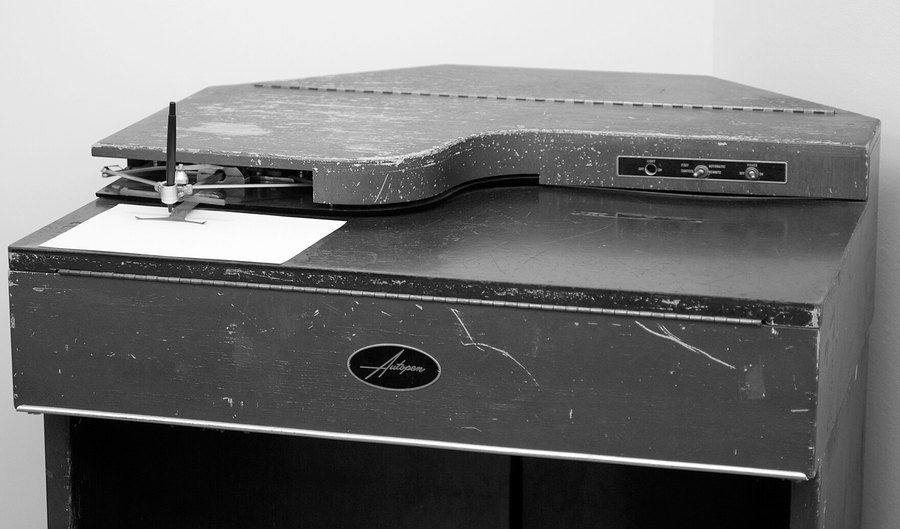
The signature machine left the cabinet of curiosities and entered public administration. The first commercially successful autopen is attributed to Robert M. De Shazo Jr., following a request from the United States Navy in the early 1940s, and it has accompanied ever since the routine of those who must sign volumes no hand could cope with. Harry Truman, president of the United States between 1945 and 1953, is cited as the first to resort to the device, albeit for cheques and correspondence, and Barack Obama was the first to sign legislation into law by means of it, already in the 2010s. Institutional use is legitimate, declared and well known.
The equipment in the image alongside belongs to that generation: a metal cabinet with an articulated arm, a control panel and the sheet positioned under the pen. Heavy, expensive and of restricted access, it imposed on fraud a practical barrier that no longer exists today.
Institutional autopenArticulated arm, control panel and a real pen on the paper.
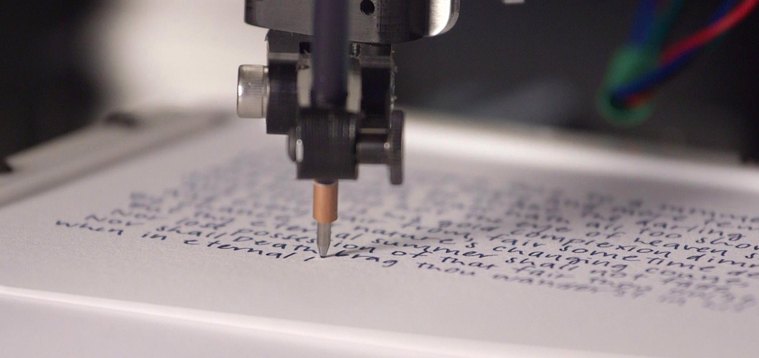
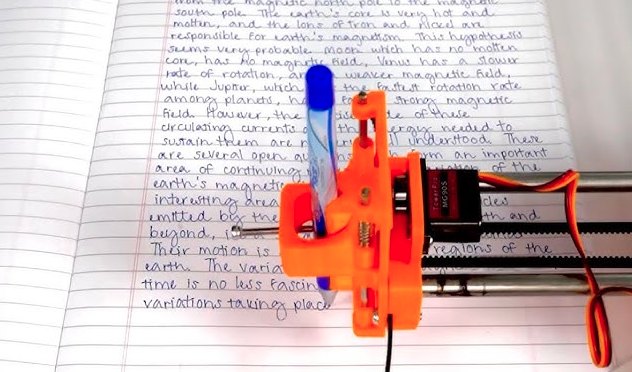
The third generation dismantled the barrier. Pen plotters and 3D-printed heads, sold openly and assembled from common parts, execute the same principle on any paper: the vector guides the pen, and the result is running script with a handwritten appearance. Legitimate use is vast, from invitations to certificates. The abuse is equally evident, and it has reached the courts: entire handwritten documents, not just signatures, produced by machine and presented as written by hand.
Plotter head with an ordinary pen: the line comes out continuous, but with a regularity the hand cannot sustain.
3D-printed part: equipment that produces a whole page of writing, not just the signature.
What changes for the examination
When the machine writes the entire text, classic handwriting comparison is not enough
Faced with a handwritten document produced entirely by equipment, the examination does not look for anyone's hand: it looks for the traces of the machine. Regularity of speed and pressure across whole pages, ink build-up at stopping points, identical repetition of characters that should vary with each occurrence, and a baseline alignment far too constant for free writing. It is the same principle as the individualisation of type elements in typewriting examination, applied now to the handwritten stroke.
How the fraud is carried out
VectorisationA legitimate signature is scanned and converted into vector coordinates, point by point
Real instrumentA ballpoint, gel pen or fountain pen is fixed to the mechanical arm or to the moving head
ExecutionThe equipment runs along the vector over the paper, depositing real ink and leaving a furrow: at first sight, everything looks authentic
VariantsDedicated signature machines and adapted cutting plotters perform the same function with mechanical precision
The evidence the machine cannot fake
No person signs twice in exactly the same way
If two signatures on different documents coincide point by point when superimposed, along the whole of the tracing, these are not two signatures: this is the same matrix reproduced twice. Natural variation is the mark of a living hand, and it is precisely what the equipment cannot imitate. Tracing also produces coincidence of form, and the distinction between the two is drawn from the remaining traces: the traced stroke is slow and retouched, the mechanical one is fluent and far too regular.
What magnification reveals
The traces the machine does not erase
Traces of the mechanical stroke
Constant speed: the machine neither accelerates on straights nor slows down on curves, as the hand does
Uniform pressure from start to finish, without the alternation of thicker and thinner strokes
Circular ink build-ups at starting and stopping points, where the pen remains motionless for an instant
Absence of physiological micro-tremors: lines far too clean to have come from a hand
Identical superposition between specimens that should merely resemble one another
How the examination confirms it
High-resolution microscopy: pigment distribution at the edges of the stroke
Raking light and reading of the reverse: depth and constancy of the pressure furrow
Measurement of angular regularity and of the estimated writing speed
Comparison by superposition between the questioned specimens
Examination of substrate and ink, to place the entry within the timeline of the document
Mechanical forgery is not to be confused with tracing, in which the forger outlines by hand a model placed under the sheet, nor with self-forgery, in which the holder himself distorts the stroke in order to deny it later. These are three distinct frauds, with distinct traces, and the expert report must state which of them it found.
Representative cases
The level of work you are engaging
Before deciding, it is worth seeing what has already come through this laboratory: cases described without identifying the parties, in the format of challenge, method and result.