Home // FORENSIC UNITS // DOCUMENT, VOICE AND IMAGE // HANDWRITING EXAMINATION

Self-Forgery of Signatures

Not every disputed signature is false. There is the reverse and more delicate case: the holder signed, deliberately altered his own gesture and now denies it. The examination tells the two apart by what the writer's hand cannot hide.

The hypothesis few people raise

What if the signer was the writer himself, disguising the stroke?

Forensic routine is well acquainted with forgery by imitation: someone copies another person's gesture. There is, however, the opposite movement, and it accounts for a significant share of the signatures disputed in court. The holder signs, deliberately distorts his own stroke and, months later, denies the act alleging forgery. This is self-forgery, also called a disguised signature or disguise by self-falsification.

The calculation behind it is simple: whoever distorts his own signature knows it will not match the exemplars, and counts on a hasty expert report confirming the formal divergence. An examination conducted with method takes another route and frequently reaches the opposite conclusion.

That is why the examination does not stop at the shape. A signature invented on the spot, with no habit behind it, comes out different at every attempt. A signature fixed by habit repeats, under any disguise, a set of elements the writer does not control, and it is on that set that the comparison rests.
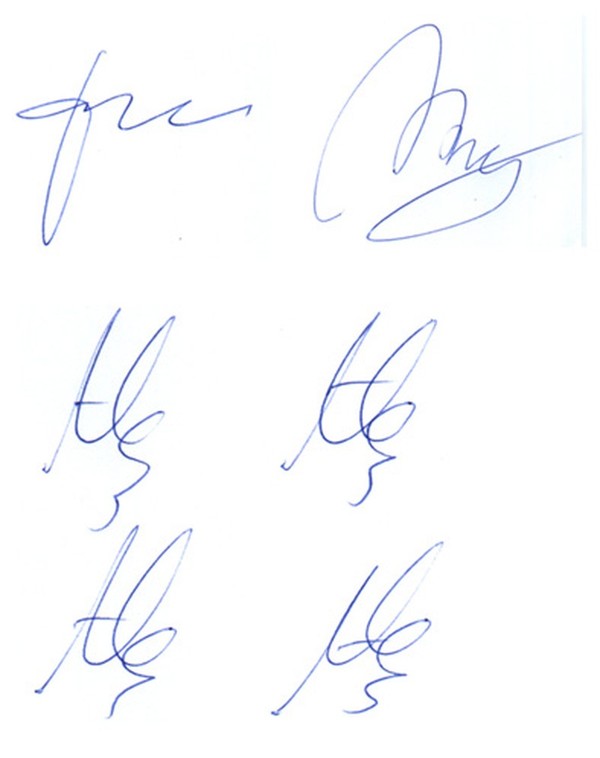
Above, two signatures invented on the spot, with no resemblance to each other; below, four natural signatures by the same person, with a stable line
Above, two "signatures" invented on the spot by the same person: the graphic features do not repeat from one to the other. Below, four natural signatures by that same person, with the stable line that habit has fixed.
Figure: Anna Koziczak, Intentional Handwriting Modifications (Forensic Sci Add Res, 2023) · CC BY 4.0
Forgery by imitation
  • Slow stroke, produced under the watch of the eye
  • Command tremors and undue stops along the path
  • Retouching and reinforcement to correct the design
  • Uniform pressure, without the natural axis of the writer's hand
  • Form sometimes convincing, dynamics always poor
Self-forgery
  • Fast, fluent stroke: the writer's hand is the usual one
  • Initial attacks and terminal strokes preserved by automatism
  • Graphic minima unchanged, because they escape control
  • Alteration concentrated in what is visible: size, slant, flourishes
  • Different form, identical genesis
The principle that underpins the examination

The graphic gesture is commanded by the brain, not by the hand

It is Solange Pellat's lesson that structures the distinction: habitual writing is not modified at a single stroke, and the writer who tries to distort it alters the form without reaching the genesis. Elements of a general order, visible to any reader, change. Those of a genetic order, invisible to the lay reader and to the writer himself, remain.
Scientific grounding

What more than twelve thousand signatures revealed about people who distort their own

The intuition described above is no longer merely bench experience. Research published in the Archives of Forensic Medicine and Criminology examined more than twelve thousand signatures collected from two hundred people, who were tasked with deliberately altering their own handwriting so as not to be recognised as its authors, without the alteration looking artificial. For the final assessment the researchers selected precisely each participant's most successful attempts, the ones that would present an examiner with the greatest degree of difficulty.

The result confirms a stable pattern of behaviour. Whoever distorts his own signature concentrates the effort on what catches the eye, on the so-called pictorial effect of the mark, and leaves untouched the features he does not notice or whose very existence he does not suspect. It is in that asymmetry that the examination finds its answer.

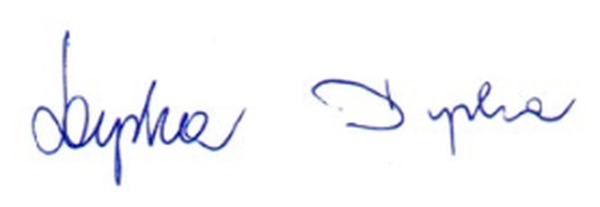
Two legible signatures by the same person: one self-forged and one natural, with the overall shape altered and the underlying features preserved
Self-forgery in a legible signature: the overall shape changes, but the set of features beyond the writer's control stays in place, and it is that set which sustains the comparison.
Anna Koziczak, Signatures as an object of autoforgery (self-forgery), Archives of Forensic Medicine and Criminology, vol. 73, no. 3, pp. 257-271, 2023.
What writers alter most
84%Structure of the characters in the opening part of the signature
57%Structure of the characters in the middle part
51%Structure of the characters in the final part
46%Size of the signature
43%Legibility
39%Impulse of the gesture
34%Writing speed
32%Axial slant
What they almost never alter
1%Presence or absence of additions and complements
2%Manner of execution of the signature
4%Arrangement of the characters in relation to one another
5%Shape of the signature line
7%Placement of the signature in relation to the baseline
8%Direction and tendency of the baseline
8%Spacing between the elements
A documented case

What changed and what stayed, in a real self-forgery

The same study describes, signature by signature, what one writer managed to alter in his own legible signature and what stayed the same without him noticing. It is the asymmetry in its purest form.

What the writer altered
  • the structure of the first letter of the surname and of letters in its middle part
  • the size of the signature
  • readability, which came out higher than usual
  • impulse, which came out lower
  • the height of above-line components, lowered against the mid-line
What stayed, without him noticing
  • the structure and connections in the final part of the surname
  • the space between the surname and the first-name initial
  • the number of components and the order in which they are drawn
  • the degree and characteristic manner of shortening the first name
  • the additions, such as the absence of a dot after the initial

A case of autoforgery in a legible signature described by Anna Koziczak, Signatures as an object of autoforgery (Archives of Forensic Medicine and Criminology, vol. 73, no. 3, 2023).

The diagnostic inversion

The inverted signal is what distinguishes the two frauds

In self-forgery, the divergences appear in the foreground features while agreement is maintained in the secondary ones: the more individualising those preserved features are, the more their persistence between the questioned signature and the exemplar points to the writer's own hand, even though the general form has changed. In forgery by imitation the picture is exactly the opposite: the forger copies what is visible and goes wrong precisely in the secondary features. Reading a disputed signature by similarity of form alone is looking at the wrong side of the evidence.

Source: KOZICZAK, A. Signatures as an object of autoforgery (self-forgery). Archives of Forensic Medicine and Criminology, v. 73, n. 3, p. 257-271, 2023. DOI 10.4467/16891716AMSIK.23.021.19321.

What is at stake

Denying one's own signature has consequences

Once the authenticity of a private document is challenged, it ceases to be trusted until its truthfulness is proven (CPC, art. 428, I, Brazilian Code of Civil Procedure), and the burden of that proof falls on the party that produced the document (CPC, art. 429, II). This is why the challenge is used as a strategy: it shifts the cost and the risk of the forensic examination to the other party.

When the examination shows that the disputed signature came from the very hand of the person who denied it, the strategy turns against its author. Altering the truth of the facts amounts to litigation in bad faith (CPC, art. 80, II), with the penalties of CPC, art. 81, and the episode taints the credibility of everything else that party has claimed in the proceedings.

On the other side, for someone accused of forgery, the same examination is the most effective defence: showing that the stroke came from the holder's own hand removes the need for witness testimony to dispel the accusation.

CPC, art. 428, IA challenged private document ceases to be trusted until its truthfulness is proven
CPC, art. 429, IIOnce authenticity is challenged, the burden of proof lies with the party that produced the document
CPC, art. 80, IIAltering the truth of the facts amounts to litigation in bad faith
CPC, art. 81Fine and compensation to the party harmed by the bad-faith conduct
ExemplarsThe examination requires contemporaneous exemplars of unquestionable origin, taken before the dispute whenever possible

How the handwriting comparison is conducted →

Representative cases

The level of work you are engaging

Before deciding, it is worth seeing what has already come through this laboratory: cases described without identifying the parties, in the format of challenge, method and result.

See all representative cases →

The technical evidence your case requires. The authority courts respect.

Initial feasibility consultation at no cost. Reply within 24h on business days.
Request an Examination