Home // FORENSIC UNITS // DOCUMENT, VOICE AND IMAGE // HANDWRITING EXAMINATION

Signature by Proxy

When the holder does not sign and a third party signs for them, the examination changes its object: what is compared is not the hand of someone who never wrote, but the regularity of the act, the handwriting of the person who signed and the fingerprint affixed.

What it is

Someone signed for another person. Is that valid?

Signature by proxy, commonly known in everyday practice as the fingerprint signature, is the one a third party writes on behalf of someone who cannot sign: an illiterate person, someone who has lost their sight, someone whose arm is immobilised, someone weakened by illness. The third party signs a rogo, that is, at the request of the holder, and the act is completed by the presence of two witnesses who subscribe the document.

Brazilian law recognises this arrangement in more than one place. In a services contract in which one party can neither read nor write, the instrument may be signed by request and subscribed by two witnesses (CC, art. 595, Brazilian Civil Code). In a public deed, if a party appearing before the notary cannot or does not know how to write, another legally capable person shall sign for them, by request (CC, art. 215, § 2). In a public will, if the testator cannot or does not know how to sign, the notary states this and one of the attesting witnesses signs at the testator's request (CC, art. 1,865).

The act is therefore valid. The problem arises when it is used as a facade: the document states that there was a request, but what actually happened was something else.

The popular name explains why so many people look for the examination under that label: in notarial practice and in credit agreements, whoever does not sign presses a thumb in place of the signature, and it is the fingerprint that remains on the paper as the holder's mark. Technically, however, these are two distinct acts and both must be examined: the signature by proxy, written by the third party, and the fingerprint, which is the trace left by the person themselves.
CC, art. 595Services contract with a party who can neither read nor write: signature by proxy and two witnesses
CC, art. 215, § 2Public deed: a legally capable person signs for the party who cannot or does not know how to write
CC, art. 1,865Public will: an attesting witness signs at the testator's request, with a statement by the notary
CPC, art. 429, IIOnce authenticity is challenged, the burden of proof lies with the party that produced the document (Brazilian Code of Civil Procedure)
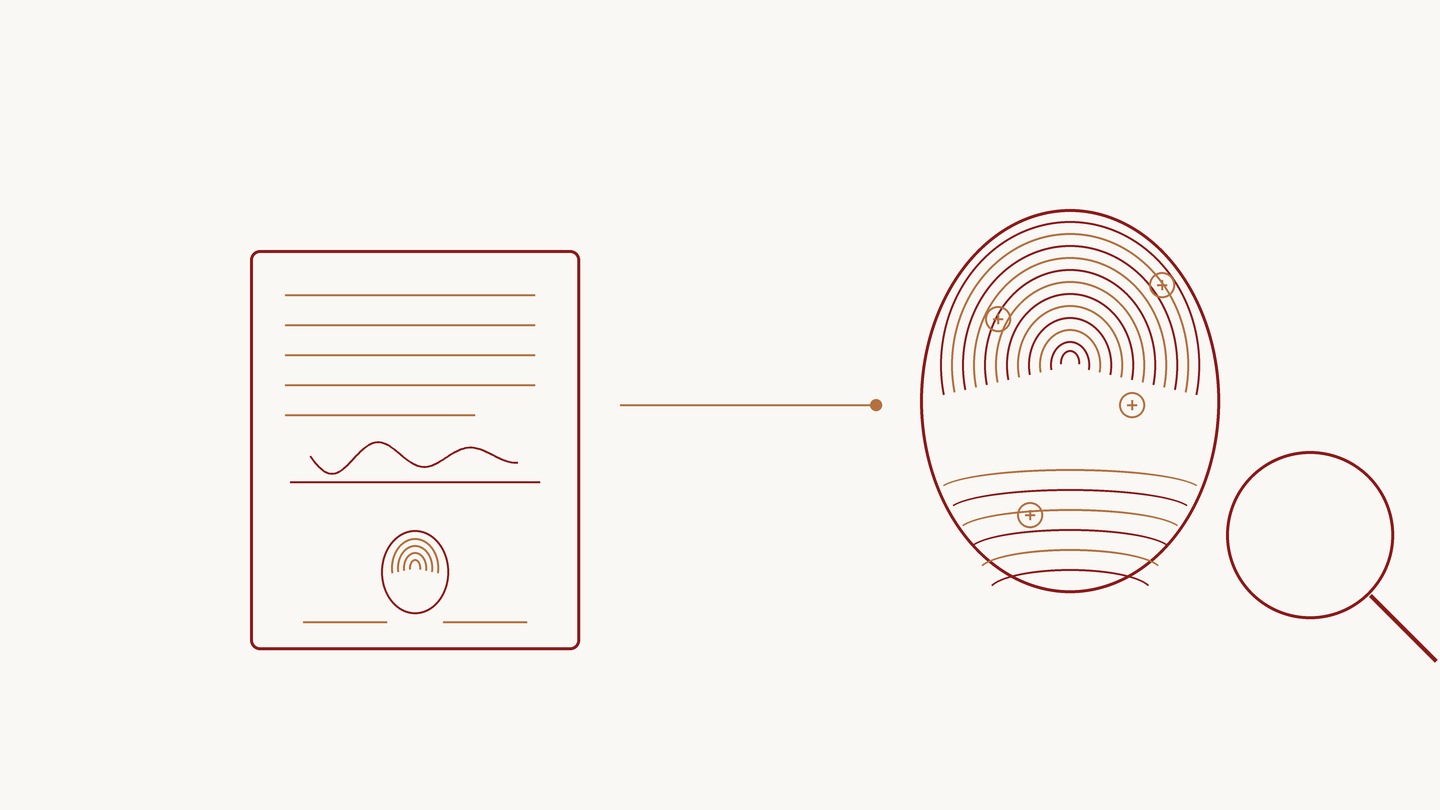
Fingerprint signature: the document with the initials of the person signing by request and the holder's fingerprint, and the fingerprint enlarged with minutiae under comparison
The mistake that defeats the examination

Requesting a handwriting comparison of someone who never signed

It is the most common and the most useless request in these cases: comparing the holder's signature when the document, by definition, carries no signature by the holder. The person who wrote the stroke was the one signing by request. The examination must change its object, and that is what separates a usable expert report from one that answers nothing.

Object 01

The formal regularity of the act

Does the document expressly state that it was signed by request? Does it identify who signed and on whose behalf? Does it carry the two required witnesses, with their details? The absence of these formalities is not a bureaucratic detail: it is what upholds or brings down the instrument.

Object 02

The handwriting of the person who signed by request

Is the signature actually that of the person named in the document as signing by request? Here there is a classic handwriting comparison, but against the third party's exemplars, not the holder's. If that person denies having signed, the examination answers the question.

Object 03

The fingerprint affixed

In instruments drawn up before a notary and in credit agreements, the signature by proxy is almost always accompanied by the holder's fingerprint. That fingerprint can be examined, and it is frequently what decides the case. See the examination of fingerprints on documents.

Object 04

The simulation of the holder's signature

The opposite scenario: the document states no request at all and carries a signature attributed to someone who could not write. In that case, the examination demonstrates the incompatibility between the stroke written on the document and the holder's graphic ability.

Where this appears most

Payroll loans, pensions and the elderly person who never wrote

Loans taken out in the name of illiterate or bedridden people, powers of attorney granting broad authority, deeds to the family home and releases. In all of them, the same technical question: was the act by request real and regular, or was the formula used to give an appearance of legality to something nobody authorised?

How the examination proceeds

From the questioned document to the expert report

ScreeningReading of the instrument: is there a statement of request, an identification of the person who signed and two witnesses? Is the original document available?
ExemplarsCollection of exemplars from the person who signed by request and, where appropriate, from the holder, under the four requirements of the examination: authenticity, contemporaneity, suitability and quantity
HandwritingComparison of the written stroke against the exemplars of the person who signed by request, with macro and microscopic photographic records
FingerprintWhere a fingerprint is present, examination of its usability and comparison of minutiae with a collected exemplar
SubstrateExamination of the paper, the inks and the printing: interpolations, later additions and page substitution
Expert reportA conclusion on a stated scale, with the limitations of the material set out before any assertion

Explore the Forensic Handwriting and Questioned Document unit →

Representative cases

The level of work you are engaging

Before deciding, it is worth seeing what has already come through this laboratory: cases described without identifying the parties, in the format of challenge, method and result.

See all representative cases →

The technical evidence your case requires. The authority courts respect.

Initial feasibility consultation at no cost. Reply within 24h on business days.
Request an Examination