Home // FORENSIC UNITS // DOCUMENT, VOICE AND IMAGE

Forensic Handwriting and Questioned Document Examination

An examination that answers the court's three questions: did this hand write this signature? Who wrote this text? Was the document altered after completion? Forensic handwriting and computer forensics expert, judicial and out-of-court work throughout Brazil.

Part 1 of 2

Examining the writer's hand: forensic handwriting examination

Who wrote it, and whether they wrote it of their own free will.

Go to Part 2, examining the document ↓

Forensic handwriting examination · the writer's hand

Handwriting identifies. The document confesses.

Each examination below is a scope that can be commissioned on its own, with object, method and limits stated from the proposal onwards:

Signatures

Authenticity of a signature

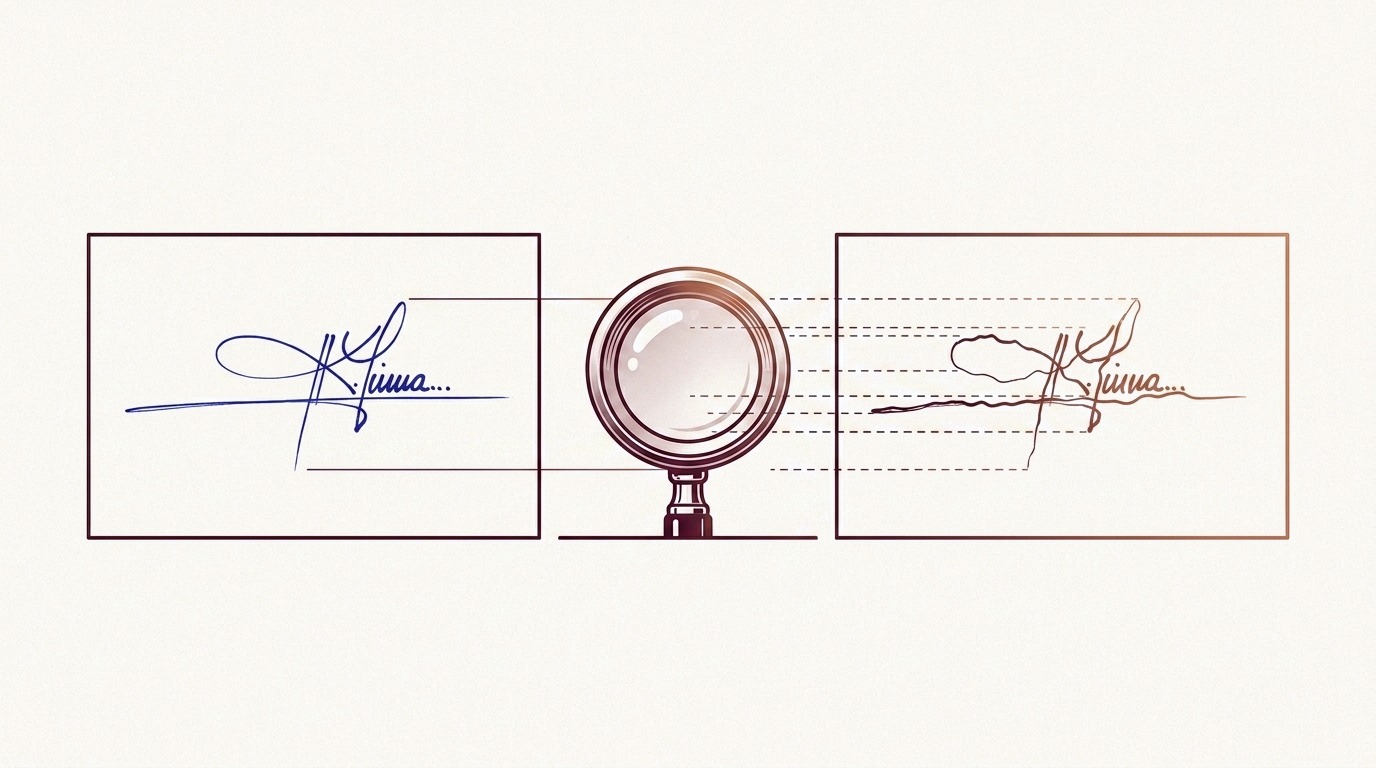
The most requested examination: did the questioned signature come from the holder's own hand? Comparison with genuine exemplars and identification of the type of forgery: slavish imitation or tracing, free imitation, forgery without imitation. The examination also tests the reverse hypothesis, disguise: the holder himself deforms the signature in order to deny it later.

Manuscripts

Authorship of unsigned texts

Notes, anonymous letters, diary entries, the filling in of cheques and forms: attribution of authorship through the graphic habits of running text, where there are identified suspects and adequate comparison material.

Alterations

Alterations and additions

Digits added to amounts, clauses interpolated into blank lines, retouched dates: verification of ink homogeneity, alignment, spacing and the moment of writing, in direct intersection with the physical examinations of questioned document examination.

Senile handwriting

Elderly and ill writers, and writing under medication

Wills, powers of attorney and contracts signed in hospital. Senile or pathological handwriting shows genuine tremor, fragmentation and loss of fluency, which an unprepared examination mistakes for forgery, and vice versa. It requires exemplars from the same phase of the writer's life.

Initials

Initials and simplified signatures

Fewer graphic elements mean less material for comparison. The examination is possible, but the degree of certainty depends on the richness of the gesture, and the expert report states that relationship frankly, rather than promising a certainty the item cannot support.

Links

Links between signatures and examination of form filling

Did the same person sign both documents? Did the text and the signature come from the same hand? Were they written at the same moment? Graphic linkage and form-filling examinations answer questions that plain authenticity cannot reach.

From the handwritten signature to the digital trace
How the examination is carried out

A stated method, from the scientific basis to the degree of certainty

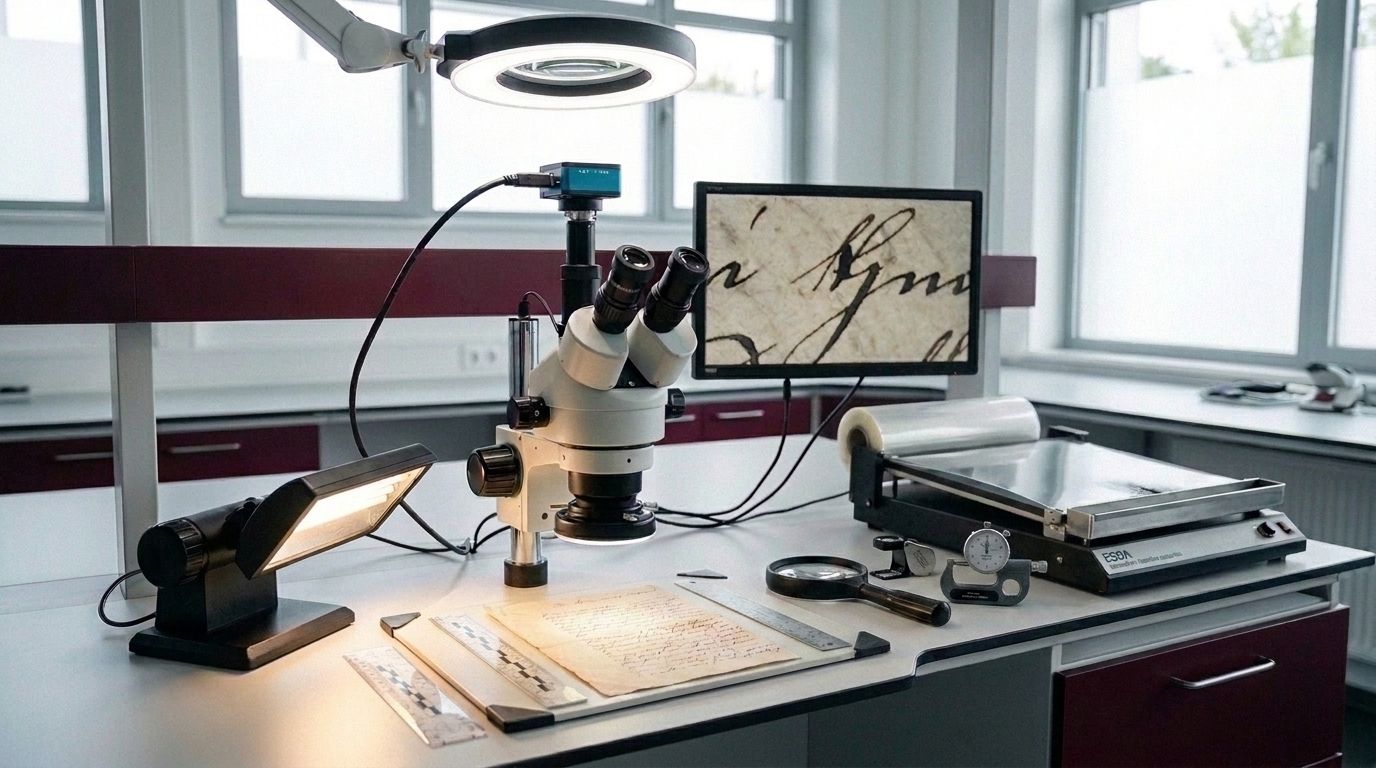
Document examination bench: trinocular microscope with camera and monitor, directed lighting, ESDA and measuring instruments
DOC LAB · Document examination benchOptics, directed light and ESDA

A handwriting expert report does not arise from a visual impression. It arises from a verifiable path that the opposing party can retrace step by step:

01 · BasisHandwriting is neuromotor automatism: nobody writes twice in an identical way, but each hand varies within a range of its own. Solange Pellat's laws of handwriting underpin the examination: the graphic gesture is under the immediate command of the brain, not of the hand; habitual writing is not modified at a single stroke; and no forger can imitate every element of a handwriting at the same time
02 · Two planes of examinationElements of a general order, visible to any reader, and elements of a genetic order, the genesis of the gesture, invisible to the lay reader and to the forger. Imitation fails on the second plane: the forger copies the form, not the genesis
03 · ComparisonThe questioned item against genuine exemplars, element by element, with macro and microscopic photographic records. The conclusion follows from convergences and divergences assessed by constancy, rarity and imperceptibility, never from "similar" or "different"
04 · Stated scaleIn line with international practice (SWGDOC, formerly ASTM E2290), the conclusion adopts a scale: identification, highly probable, indications, inconclusive, elimination. The expert report states the degree of certainty reached and why, and it is precisely this that exposes an opposing report claiming absolute certainty on precarious material
General order · the form
  • Calibre and proportions of the strokes
  • Axial slant
  • Spacing and alignment to the baseline
  • Angular and curvilinear values
  • Behaviour of stems and loops
  • Progression and apparent speed
Genetic order · the gesture
  • Initial attacks and terminal strokes: how the stroke is born and dies
  • Order and direction of the movements
  • Pressure and its rhythm: the pressure axis of the writer's hand
  • Pen lifts and progression
  • Graphic minima and complementary strokes
Comparison exemplars

An expert report is worth what its exemplars are worth

Before the examination, the decisive question is what will be used as the term of comparison. Four requirements define a good exemplar:

Requirement 1

Authenticity

Unquestionable origin: public documents and documents of recognised trustworthiness. Identity card, driving licence, bank signature card, powers of attorney and deeds executed before a notary, contracts uncontested between the parties, employment record book, personnel files.

Requirement 2

Contemporaneity

Handwriting evolves over time. The exemplars must be from the same period as the questioned item; practice recommends a window of two to three years, and the closer the better. For elderly and ill writers, this requirement is decisive.

Requirement 3

Suitability

The same graphic nature: a signature is compared with a signature, initials with initials, running text with running text. Whenever possible, the same writing instrument and the same type of substrate.

Requirement 4

Quantity

There is no magic number: there is a set sufficient to reveal the range of variation of the writer's hand. A practical order of magnitude: ten to twenty signatures from various sources, and more when the questioned item consists of initials or when the exemplars are heterogeneous.

When the supposed writer is available, taking exemplars in person is the safest route: dictation, never copying with the questioned item in view; multiple sheets; alternating texts, speeds and writing positions; a pen and substrate similar to those of the questioned item; everything recorded in a collection statement. VALLIM Perícias carries out assisted collection at a notary's office, at a hearing or at the lawyer's office.

For the lawyer, gathering the right exemplars before the expert is appointed shortens the examination and shields the report against challenge. Guidance on which documents to seek, and where, is part of the feasibility assessment, at no cost. Model questions to the expert and a collection protocol are provided together with the proposal.

Scenarios in examining the writer's hand

Every disputed signature has an examination of its own

The examinations above describe what is asked of the writer's hand. These four scenarios change the question itself, because they change the object examined, and each one requires its own method and exemplars:

Stated limits

What forensic handwriting examination does not do

  • It does not determine the absolute age of writing without a specific material examination, and not every case allows for one
  • It does not conclude authorship from impoverished initials without adequate exemplars
  • It does not infer personality: graphology is not forensic handwriting examination
  • It does not "authenticate" with full certainty on a low-resolution copy
Why limits are stated

Methodological honesty is what shields the report

A report that promises what the material cannot support is a report that falls apart under challenge. That is why the limits of the case are presented before the work is accepted, in the feasibility assessment, at no cost: what the material allows one to conclude, to what degree, and what would be needed to conclude more. Whoever commissions the work knows from the outset what the evidence can deliver.

Part 2 of 2

Examining the document: questioned document examination

What happened to the paper, the ink and the printing after the document was completed.

Up to this point, the object of the examination has been the writer's hand. From here on, it is the document. The two specialities coexist in the same case and in the same laboratory, but they answer different questions: forensic handwriting examination asks who wrote; questioned document examination asks what happened to the paper, the ink and the printing after the document was completed.

Questioned document examination · the document itself

A tampered document leaves traces in the material

Beyond the writer's hand, the substrate itself tells its story: ink, paper, printing and security features respond to specific examinations:

Counterfeiting

Total forgery × partial forgery

Is the document entirely fabricated, or is it a genuine document tampered with after completion? The distinction changes the case theory and the litigation strategy, and it is the first answer the examination delivers.

Alterations

Erasure, chemical washing and interpolation

Mechanical erasure by abrasion: raised fibres and loss of paper gloss. Chemical washing: halos and anomalous fluorescence under UV light. Additions and interpolations: divergent ink under infrared, misalignment, compression of the writing. Obliterations: what lies beneath the blotting, recoverable by infrared luminescence.

Intersections

Intersecting strokes

Which stroke was written first? The answer decides whether the signature came before or after the text, the classic hypothesis of the sheet signed in blank. Microscopic analysis of ink drag and fibre crushing, combined with the spectral response of the inks.

Dating

Relative dating and anachronisms

Compatibility between the stated date and the materials and technologies of the document: an ink formulation available at the time, paper weight and whiteness, the printing technology of the form, the layout version, an anachronistic company registration number, telephone number or postcode. Chemical ink dating through a network of partner laboratories, under chain of custody, with feasibility stated case by case.

Substrate

Paper, printing, stamps and seals

Identification of the printing process (offset, electrophotography, inkjet), linking a rubber stamp to its die, examination of seals and revenue stamps, watermarks and indented writing: what was written on the sheet above and recorded on the one below.

Identity

Identity and security documents

Identity cards, driving licences, passports, vehicle registration certificates: security backgrounds, microprinting, holograms, programmed fluorescence, intaglio printing, substitution of photographs and data. A recurring examination in banking fraud, digital onboarding and internal investigations.

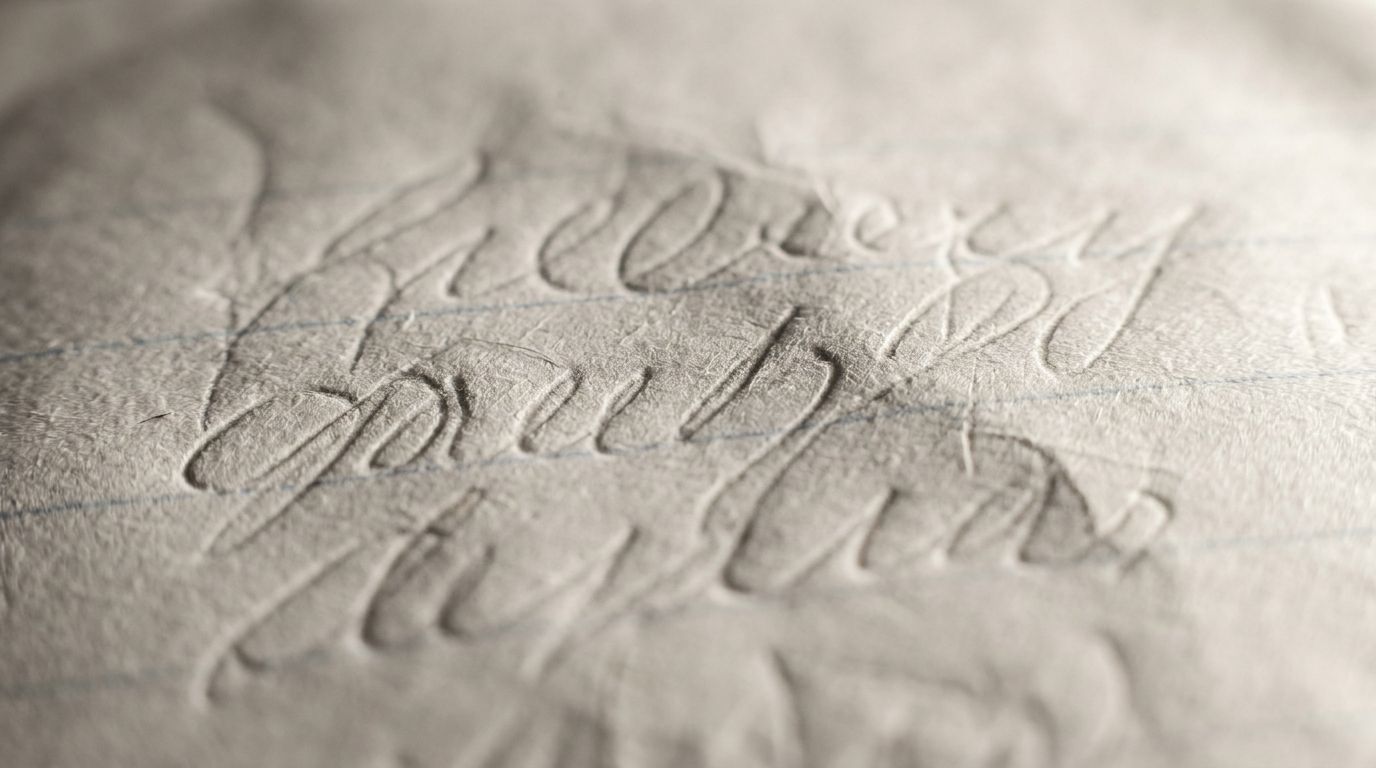
Indented writing: the pen furrow revealed by oblique lighting, with no ink on the paper

One example of what the substrate reveals: the sheet lying under the document being written receives no ink at all, yet it retains the furrow of the pen's pressure. Under oblique lighting, almost parallel to the paper, the relief casts micro-shadows and the indented writing appears: this is the examination of indentations, capable of recovering what was written on sheets nobody saw being written.

The laboratory

Instruments presented as method, not as a catalogue

Each light source and each magnification answers a specific question of the examination:

Stereomicroscope and measuring loupeStroke morphology, ink intersections, graphic minima and retouching
UV light 365 nmFluorescence of paper and inks, halos from chemical washing, programmed security features
InfraredReflectography and luminescence: differentiation of metameric inks and reading of what lies beneath obliterations
Oblique lightPressure furrows and paper relief, invisible under frontal lighting
ESDAElectrostatic detection apparatus: recovers the indented writing recorded on the sheets below, even with no visible furrow. What was written on top of the pad remains legible pages later
Transmitted lightWatermarks, interpolations, patches and heterogeneities in the paper
Calibrated photomicrographyA record that illustrates the report and allows the judge to check each finding with their own eyes
Partner laboratory networkVideo spectral comparator (VSC), advanced spectral examinations and chemical ink dating through a network of partner laboratories, under chain of custody, when the case allows for them
Scenarios in examining the document

When the object is the body of the document

When the challenge does not fall on the signature but on the body of the document itself, the examination changes both its instruments and its scope:

The question of the scanned document

Examining a copy: what a scanned PDF allows, and what it hides

Electronic court filing has transformed daily practice in the field: more and more, what reaches the case file is the image of a piece of paper nobody has seen. The honest answer has two sides:

What scanning destroys
  • The pressure of the stroke: the furrow left in the paper
  • The order of the ink intersections
  • Fine retouching and the nature of the writing instrument
  • And most serious of all: the ability to rule out a montage. A genuine signature, digitally cropped from another document, looks perfect in the copy precisely because it is genuine
What a copy still allows
  • Morphological analysis: calibre, slant, proportions, graphic behaviours
  • Exclusion of authorship where the divergence is plain
  • Detection of gross symptoms of tracing
  • Detection of duplication: two "signatures" identical point by point betray mechanical reproduction, since no hand repeats itself exactly

The position stated in the report: on a copy, a negative conclusion can be firm; a positive conclusion of authenticity comes out with a lowered degree of certainty, and the report says so in as many words. The Brazilian Superior Court of Justice has admitted forensic examination of a scanned document "subject to the applicable limitations", and courts have rejected it where a montage was suspected. The lawyer who grasps that distinction before the expert is appointed avoids a report that can be annulled.

And there is the bridge that few build: when the document is scanned, the handwriting examination must be accompanied by a digital questioned document examination of the file itself, covering metadata, layers, the PDF editing history and signs of montage. The same expert masters the stroke on paper and the trace in the system, under a single method and a single technical responsibility.

A categorical report on a copy is a fragile report

Absolute certainty of authenticity asserted on a scanned document does not withstand adversarial scrutiny: a copy preserves no pressure, preserves no intersections and does not allow a montage to be ruled out. When the opposing report ignores those limits, the technical counter-evidence points out, point by point, where it does not hold up.

Digital Questioned Document Examination: examining the file →   Electronic Signatures →

The flagship

The document has changed its nature. Very few experts have kept up.

Contracts are born on platforms, signatures become cryptographic certificates, receipts circulate through apps. Examining today's document requires what classical training in questioned documents does not provide: a deep command of computer forensics. Without it, metadata, audit trails and the very structure of the file go unnoticed, and the error turns into a court ruling.

This is where this unit stands out: the same expert who masters the stroke on paper masters the trace in the system. Classical handwriting and questioned document examination, digital questioned document examination and electronic signatures, under a single method and a single technical responsibility.

Explore Digital Questioned Document Examination →   Electronic Signatures →

Who it is for

Three ways in, one and the same method

Lawyers

Forgery incidents and party-appointed expert work

Allegation of forgery (CPC, art. 430 et seq., Brazilian Code of Civil Procedure), drafting of questions to the expert, following the official examination as a party-appointed expert (technical assistant) and issuing a dissenting opinion on an opposing report, with analysis of the method used by the court-appointed expert.

Companies

Document fraud and internal investigations

Documents forged in internal investigations, fraud in public tenders, tampering with HR records and employment record books, document verification in onboarding and credit. Scope defined together with the legal and compliance teams.

Individuals

The signature you do not recognise

A disputed banking contract, a fraudulent payroll loan (the number one mass litigation in the field), wills and estate division, promissory notes and receipts. One of the few units offering direct service to individuals, starting from a feasibility assessment at no cost.

See also

Digital Questioned Document Examination →   Electronic Signatures →   Expert Reports and Technical Opinions →

Completed cases

Document examination in practice

ANONYMISED CASE

Challenge to a banking contract with an allegedly forged signature

Forensic handwriting examination identified technical divergences that supported the declaration of forgery and the annulment of the contract.

ANONYMISED CASE

Dispute over a digital contract signed on the DocuSign platform

Forensic analysis of metadata and logs revealed that the signature had been made from a device the contracting party had never used.

Every document case begins with the honest question: is an examination feasible?

Feasibility assessment at no cost: the material is analysed, the limits are stated in writing and the proposal sets out scope, timeframe and fees before any commitment. Reply within 24 hours on business days.

Request a feasibility assessment
Frequently asked questions in this unit
Do I need the original document, or will a copy do?
The original is always the ideal scenario: on it one can examine stroke pressure, ink intersections and the substrate. On a copy, a negative conclusion can be firm, but a positive conclusion of authenticity comes out with a lowered degree of certainty, and the report states that limitation. When the document is scanned, examination of the file (metadata, layers, signs of montage) complements the handwriting examination. The feasibility assessment indicates frankly what the material in the case allows one to conclude.
How many signatures, and which documents, serve as exemplars?
Four requirements define a good exemplar: authenticity (unquestionable origin), contemporaneity (the same period as the questioned item, ideally within two to three years), suitability (signature with signature, initials with initials) and quantity (an order of magnitude of ten to twenty signatures from various sources). Good exemplars: identity card, driving licence, bank signature card, powers of attorney and notarial deeds, uncontested contracts, employment record book. Collection guidance is provided case by case, before the examination.
What if the person said to have signed has already died?
The examination remains possible with posthumous exemplars: notary offices (powers of attorney, deeds, signature cards), banks (signature cards, contracts), the social security authority and public bodies, as well as family documents such as letters, diaries and dedications. In contested probate and will disputes, the guided search for such exemplars is usually the first step of the work.
Is forensic handwriting examination the same as graphology?
No. Graphology attempts to infer personality from handwriting and has no evidentiary value. Forensic handwriting examination is a forensic discipline: it compares measurable graphic habits in order to demonstrate authenticity or authorship, with a method accepted in court and a conclusion on a stated scale.
Is it possible to know when the document was signed?
At two levels. Relative dating checks for anachronisms: ink, paper, printing technology and data incompatible with the stated date. Absolute chemical dating of ink is carried out through a network of partner laboratories, under chain of custody, and not every case allows for it: feasibility is stated before any commitment.
Is a "shaky" signature by an elderly person a sign of forgery?
Not necessarily. Senile or pathological handwriting shows genuine tremor, fragmentation and loss of fluency, technically distinguishable from the tremor of a slow imitation: the former coexists with preserved automatisms of the writer's hand; the latter betrays a drawn copy. The examination requires exemplars from the same phase of the writer's life, and it is one of the niches in greatest demand in wills and powers of attorney.
How much does it cost and how long does it take?
Fees depend on objective criteria: the number of questioned items, the quality and quantity of exemplars, the need for instrumental or laboratory examinations and procedural urgency. After the feasibility assessment, at no cost, the proposal sets out a fixed scope, timeframe and price, with no surprises during the work.
I denied signing the contract. Who has to prove the signature is mine? Who pays for the examination?
The Brazilian Superior Court of Justice settled the matter in Repetitive Appeal Theme 1061: once the authenticity of a signature on a banking contract is challenged, it is for the financial institution to prove that it is authentic (CPC, arts. 369 and 429, II), and the cost of the examination producing that proof falls on the bank. This is the standard underpinning litigation over payroll loans and unrecognised contracts, and the reason why a prior technical assessment of the signature strengthens the challenge from the very first pleading.
The judge has already appointed an expert. Do I still need a party-appointed expert?
The court-appointed expert works for the proceedings, not for the party. The party-appointed expert follows the official examination, drafts questions to the expert, checks the method applied and produces an opinion, whether concurring or dissenting. In cases of significant value, this is the difference between accepting the report as it stands and subjecting it to technical scrutiny. Details at Judicial and Out-of-Court Forensic Examination.
Representative cases

The level of work you are engaging

Before deciding, it is worth seeing what has already come through this laboratory: cases described without identifying the parties, in the format of challenge, method and result.

See all representative cases →

The technical evidence your case requires. The authority courts respect.

Initial feasibility consultation at no cost. Reply within 24h on business days.
Request an Examination