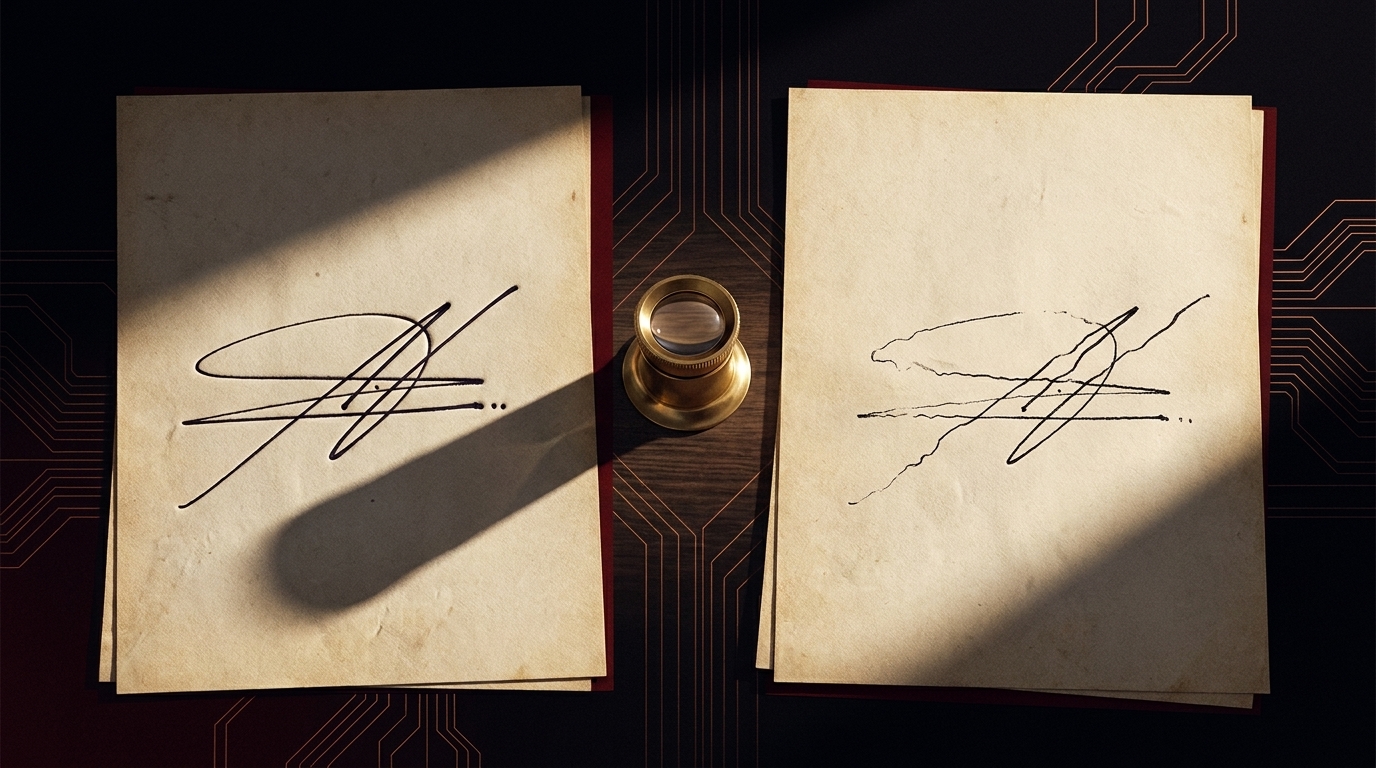
"That signature is not mine." The sentence opens thousands of lawsuits every year: the payroll loan the retiree never contracted, the contract that surfaces in the probate case, the corporate amendment the partner knows nothing about, the receipt nobody signed. On the other side, the symmetrical accusation: the false claim of forgery, from someone who signed and later regretted it. Between the two versions stands the forensic handwriting examination, one of the oldest disciplines in forensics, and one of the most mistreated by superficial reports.
What the forger cannot imitate
Writing is an automated gesture. After thousands of repetitions over a lifetime, the signature leaves conscious control and becomes movement: speed, rhythm, pressure varying along the stroke, the peculiar way of attacking the first letter and finishing the last, the connections between elements, the internal proportions the hand keeps without its owner noticing. The imitator copies what he sees: the form, the drawing, the static result. What he does not see, he does not copy: the dynamics. Careful forgery tends to be slow, and slowness leaves marks: the tremulous stroke where it should be fluid, the uniform pressure where it should vary, the stops and restarts where the true hand does not hesitate, the touch-up the legitimate author would never make. That is why the "visually perfect" imitation falls in the examination: it is a drawing of the signature, not a signature.
"The forger copies the drawing; he does not copy the gesture. The genuine signature is a movement executed without thinking, and it is exactly what is not thought that the examination measures."
The report is worth what the reference samples are worth
Before the examination, the decisive question is the comparison material. Four requirements define a good set of reference samples: authenticity (unquestionable origin: public documents, the bank's signature card, deeds, uncontested contracts), contemporaneity (handwriting evolves, and samples from the same period as the questioned piece are worth gold, a decisive requirement for the elderly and the infirm), suitability (a signature compares with a signature, running text with running text, on the same type of writing instrument when possible), and quantity (there is no magic number, there is a set sufficient to reveal the hand's range of variation; in practice, ten to twenty specimens from diverse sources). A report signed on two samples from a different era is a report born fragile, and the technical challenge starts right there.
The original, the copy, and honesty about the medium
The ideal scenario for the examination is the original document: on it one can examine the stroke's pressure on the paper, the ink crossings, the order of the entries, the characteristics of the writing instrument. Photocopies and scans allow analysis, but with limitations the honest report declares at the outset: the copy hides the pressure dynamics and can also hide the montage, the genuine signature transplanted from another document. A categorical conclusion over a low-quality copy is one of the most recurrent defects of weak reports in this field, and one of the easiest flanks for qualified adversarial scrutiny.
Tema 1061: when the bank bears the burden of proof
In consumer litigation, a procedural yardstick changed the game. The STJ (Brazil's Superior Court of Justice) established, in Repetitive Appeals Theme 1061 (Tema 1061), that once the consumer challenges the authenticity of the signature on a bank contract filed in the record, it falls to the financial institution to prove it is authentic (CPC, arts. 369 and 429, II, Brazilian Code of Civil Procedure), bearing the cost of the examination. For the consumer's attorney, the practical consequence is twofold: the well-grounded challenge gained force, and a prior technical assessment of the signature, even before filing, allows one to challenge with conviction instead of betting. For the institutions, the lesson is archival: organized custody of original contracts and robust contracting procedures have ceased to be bureaucracy and become defense.
The hand that truly trembles: the elderly and the infirm
A delicate chapter of these examinations involves senile and pathological handwriting. Age and illness widen the hand's natural variation: the stroke loses firmness, forms simplify, today's signature visibly differs from that of ten years ago. This picture creates the two symmetrical errors the examination must avoid: condemning as false the authentic signature of a weakened hand, and validating as "age tremor" the forgery that imitates the tremor. The technical distinction exists: genuine tremor has its own pattern, distributed organically along the gesture, while imitated tremor follows the drawing, concentrating where the forger slows down to copy. It is also here that the contemporaneity of the reference samples ceases to be a recommendation and becomes an absolute requirement: comparing the signature of an infirm elderly person with healthy samples from twenty years earlier condemns the examination to error, in either direction. Cases involving wills, powers of attorney, and contracts signed in a period of frailty deserve, more than any others, samples from the same period and a report that respects the complexity.
What to prepare when a signature raises suspicion
- Locate the original document, and resist handling it: protected custody until the examination;
- Gather authentic and contemporaneous reference samples: public documents, bank records, and uncontested contracts from the same period;
- Do not cut, laminate, staple, or "restore" the questioned document;
- Record the document's chain of possession: where it was, with whom, since when;
- Seek a preliminary technical assessment before filing: it defines the real strength of the challenge.
Modern handwriting examination works shoulder to shoulder with document examination: the study of the stroke joins the study of the medium, the inks, the printing and, increasingly, the document that was born or circulated in digital form. But the foundation has remained the same for a century: writing is individual, the gesture cannot be borrowed, and between the signature the hand made and the one the hand copied there is a distance that method measures. Whoever decides a case by the signature's appearance decides in the dark; the examination exists to turn on the light.