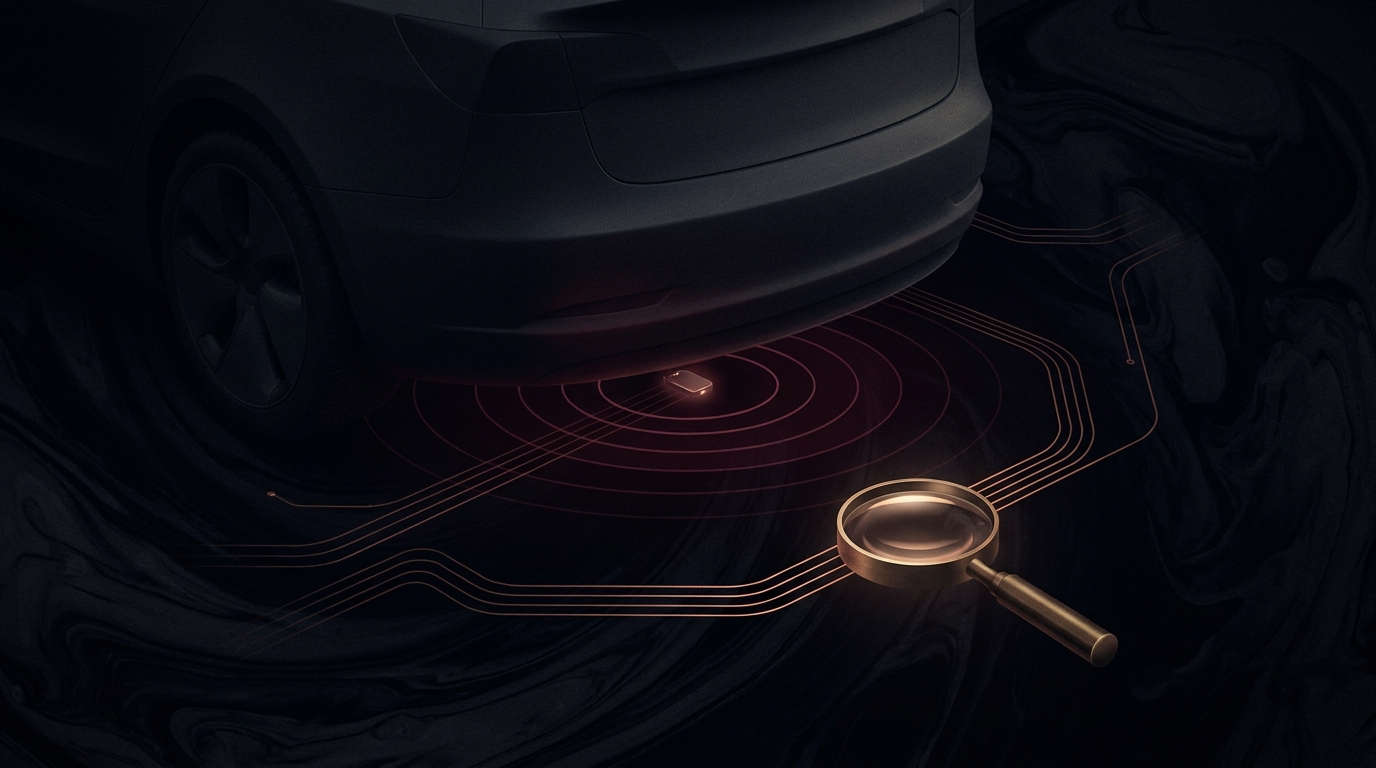
She had changed her routine, her schedule, her routes. In the middle of a contested divorce, she noticed her ex-husband still knew where she was: he would show up "by coincidence" at her workplace parking lot, mention places she had visited, know routes she had told no one about. Her phone had been checked, passwords changed, social media locked down. The answer was not in the phone: it was in the car. An electronic sweep of the vehicle, conducted by the laboratory, located a smart tag hidden inside the bumper structure, and the examination that followed walked the path back: from the tracker to the device it was registered to, and from the device to its owner.
Cases like this are no longer the exception. The same smart item tag created to find lost keys and misplaced luggage has become, in the wrong hands, an instrument of stalking, and the vehicle is the preferred target: it follows the victim on every trip, offers dozens of hiding spots, and is almost never examined.
Why smart tags became the stalker's tool of choice
Smart tags are coin-sized trackers, cheap and long on battery. They have no GPS of their own: they emit a short-range Bluetooth signal, and any compatible phone that passes nearby anonymously and automatically reports that tag's position to the manufacturer's network. It is admirable engineering for finding a forgotten backpack: billions of other people's devices work for free to locate the item. And it is precisely that reach that makes it dangerous when the goal is to watch a person: in an urban area, a tag hidden in a car updates every few minutes, without the perpetrator ever coming close.
Manufacturers reacted with "unknown tracker traveling with you" alerts and audible warnings. They help, but they do not solve the problem: alerts vary with the victim's phone ecosystem, can take hours to trigger, and tampered tags circulate with the speaker removed precisely so they make no sound. Automatic protection filters out the amateur stalker; it does not replace a technical examination.
The forensic vehicle sweep
The laboratory offers, as a regular service, the electronic sweeping of vehicles to locate hidden trackers. The work combines two fronts: detection with dedicated equipment, which identifies the radio-frequency emissions of tags even when they are away from their owner and silent, and physical inspection guided by the signal, in the spots experience has taught us to check first: bumpers, wheel wells, chassis cavities, interior linings, tow hitches.
Finding the device, however, is half the job, and this is where the forensic approach parts ways with mere "tracker hunting". A located tag is not a nuisance to discard: it is evidence. The find is photographed in place, described, removed methodically, sealed, and documented under chain of custody. A tag thrown away is a suspicion lost; a preserved tag is the trace that sustains the case.
"The tag the stalker hid to watch the victim is the very object that, preserved with method, points back at him. The instrument of the stalking becomes the proof of the stalking."
From the tag to the perpetrator
Every smart tag carries its own identifiers, and the forensic examination extracts and documents them: serial number, pairing records, data accessible through the device's own proximity interface. Those identifiers point to the account and device the tag was registered to. Confirmation of ownership is completed through the courts: with the identifiers documented in the expert report, a judicial order to the manufacturer links the tag to the device and its holder, with registration date and account data.
It is this combination, technical examination extracting the identifiers plus judicial confirmation of ownership, that has produced concrete results: in several cases handled by the laboratory, the tag → account → holder path made it possible to hold the stalker legally accountable, turning months of the victim's anguish into a fact demonstrated in the case file.
What the law says about tracking a person
In Brazil, stalking is a crime: article 147-A of the Penal Code (introduced by Law 14,132/2021) punishes repeated pursuit by any means that threatens a person's physical or psychological integrity, restricts their movement, or invades their freedom and privacy, with increased penalties when the victim is a woman targeted for being a woman. In domestic contexts, psychological violence against women (Penal Code, art. 147-B, Law 14,188/2021) and the protective measures of the Maria da Penha Act (Law 11,340/2006) also apply, and the expert report helps ground them. There is also a reflex effect in family court: material the stalker gathered by surveilling the other party is unlawful evidence (Federal Constitution, art. 5, LVI; Code of Criminal Procedure, art. 157), while the tag found and examined is lawful evidence of his conduct.
If you suspect you are being tracked
The guidance is the same that applies to every digital incident: containment with intelligence, evidence with method. A few precautions matter:
- Take your phone's unknown-tracker alerts seriously, but do not rely on them alone;
- If you find a tag on your own, do not destroy or discard it: it is the evidence that points to the perpetrator;
- Avoid announcing the discovery to the suspect: knowing without them knowing is an advantage that belongs to the victim and the investigation;
- Seek a forensic sweep: beyond locating what the alerts miss, it preserves the find with evidentiary validity;
- File a police report and bring the expert findings: stalking in Brazil is prosecuted upon the victim's complaint, and that step opens the way.
In the case that opens this article, the preserved tag and the technical-judicial path to its owner turned the feeling of being watched, which until then sounded like paranoia to everyone, into documented proof of stalking. The divorce case changed its axis, protective measures were granted on technical grounds, and the one doing the watching began answering for it. The technology that serves the crime also serves the proof: the difference lies in who examines it, and with what method.